The best checklist gives you permission to say no.
Confirm the place and purpose
A useful pre-flight checklist starts before you touch the aircraft. Write down where you intend to fly, why you are flying and whether the activity is recreational, educational or business-related. Check the current official airspace and permission requirements for that exact place and purpose. A quiet-looking field is not automatically an approved flight area.
Check any landowner or site permission separately from aviation permission. If you cannot determine whether the activity is allowed, move the lesson to a suitable authorised facility or postpone it.
Walk around the take-off area
Scan above and around the launch point for people, roads, trees, cables, buildings and animals. Identify a clear landing area and a safe alternate landing spot. Notice which direction the wind is moving and whether gusts are making leaves or flags behave unpredictably. Weather limits belong to the aircraft manual and to your own training; do not invent one universal safe wind speed.
Tell anyone assisting you what the planned route is, where they should stand and what signal means stop. If you are practising alone, use a low-complexity location that complies with the law and the aircraft’s instructions.
Inspect aircraft and controls
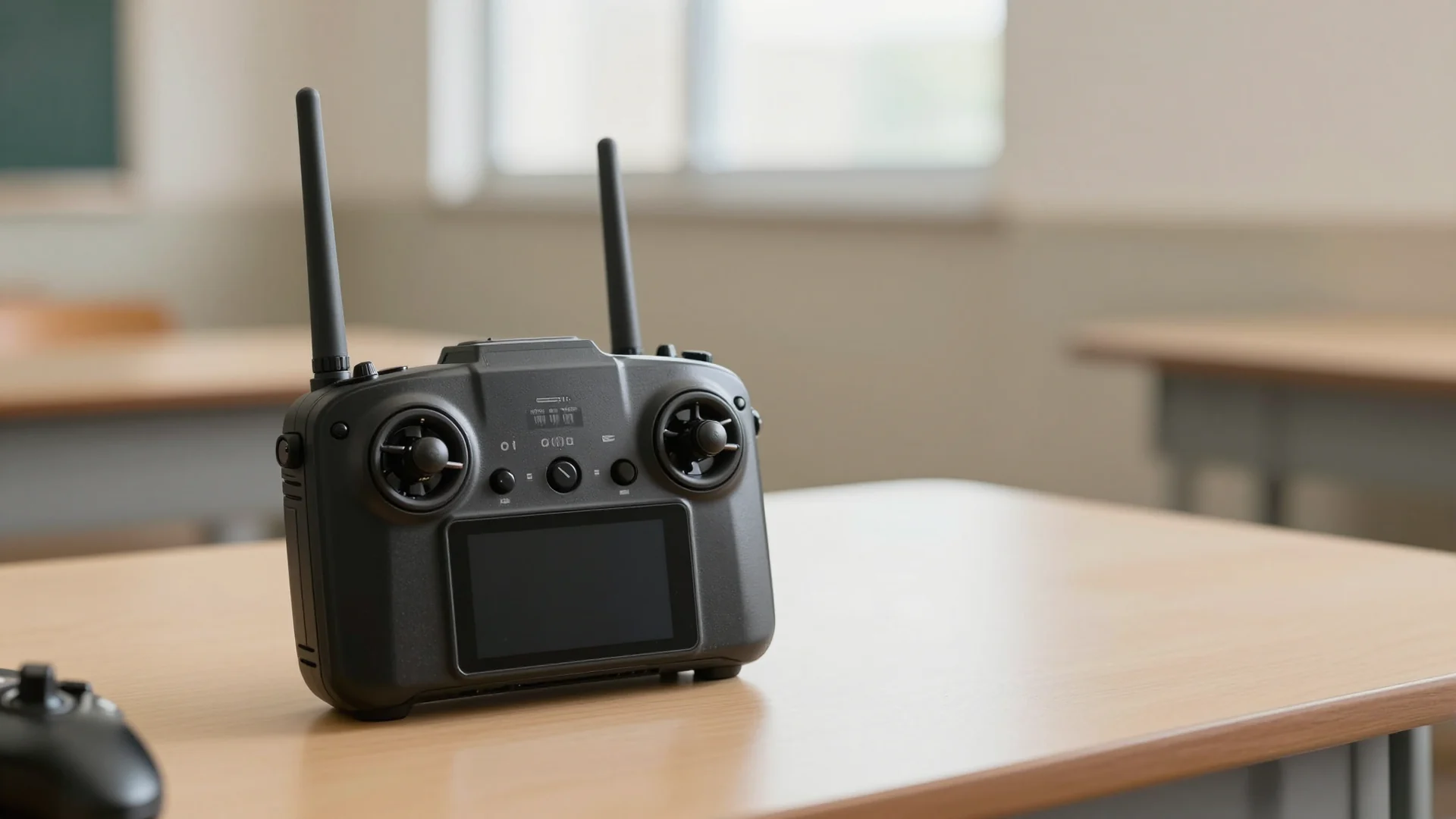
With the power off, check propellers, arms, attachments, sensors and the battery fit. Confirm that memory cards and payload items are secure and cannot interfere with a propeller. After powering up according to the manual, review firmware or app warnings, navigation status, controller connection and return-to-home settings.
Do not dismiss warnings simply to continue filming. A screen saying 'ready' is only one part of a safety decision. The pilot must still judge the environment and the legal requirements.
Make a clear go/no-go decision
Ask four final questions: Is this operation allowed here? Is the aircraft physically sound? Are the weather and surroundings suitable? Do I have enough reserve and a workable landing plan? If any answer is uncertain, the correct outcome of the checklist may be 'no flight today.'
After landing, note unexpected warnings, battery condition, unusual vibration and the location of any incident. A short log makes the next pre-flight inspection more informed.
Quick recap
- Confirm the place and purpose
- Walk around the take-off area
- Inspect aircraft and controls
- Make a clear go/no-go decision
Frequently asked questions
Do these guides authorise me to fly?
No. They are educational articles, not a licence, permit or location-specific clearance. Check the applicable regulator and permissions.
Can I rely on an academy’s promotional claims?
Treat prices, approvals and course outcomes as claims to verify against current provider terms and primary sources.
What should I do when details have changed?
Follow the latest official guidance and request a dated correction with a source link.
Authoritative sources and next reading
- CAAM UAS official guidance
- CAAS flight requirements
- Manufacturer model-specific flight manual: to be added only once the model has been chosen and source verified.
Sources and further reading
- CAAM ↗
Consult the provider or regulator for current details.
- CAAS ↗
Consult the provider or regulator for current details.
Check the original document for its scope, date and current status.
Something needs a closer look?
Suggest a correction